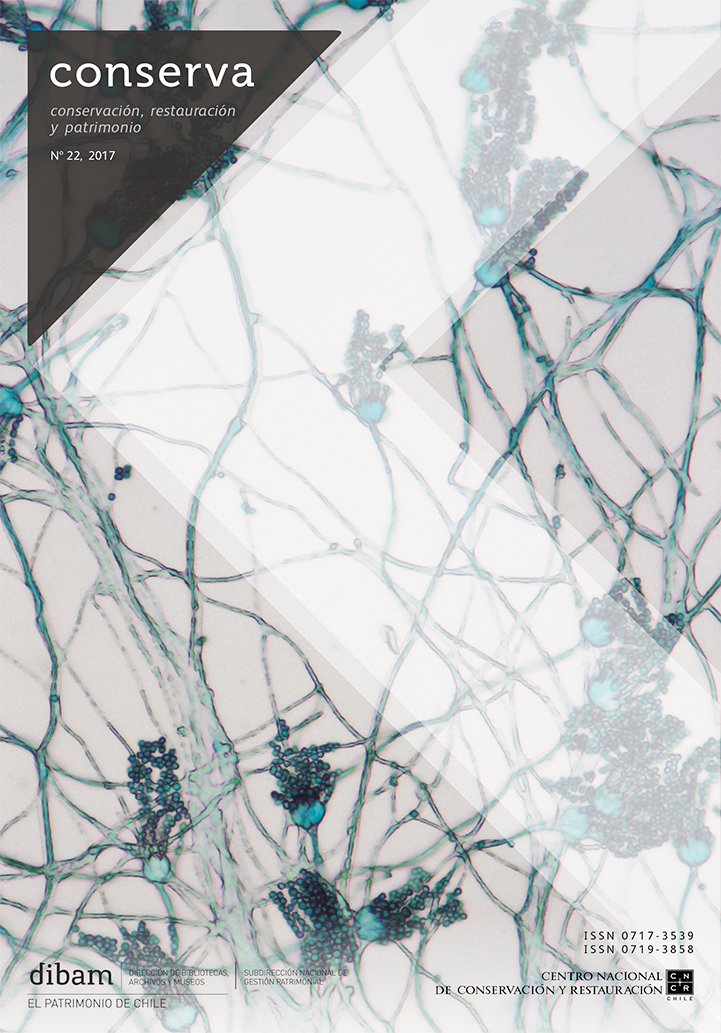
Estudio de carga fúngica al interior del Archivo Nacional. Evaluación del riesgo potencial en la conservación de colecciones y en la salud de trabajadores
Publicado 2025-12-11
Palabras clave
- carga fúngica,
- biodeterioro,
- aeromicrobiología,
- salud
Derechos de autor 2017 Catalina Zúñiga Taulis, Cecilia Rodríguez Moreno, Fernanda Espinosa Ipinza (Autor/a)

Esta obra está bajo una licencia internacional Creative Commons Atribución-NoComercial-SinDerivadas 4.0.
Cómo citar
Resumen
La carga microbiológica de aire en áreas cerradas puede ser un riesgo de contaminación para objetos y trabajadores. En este trabajo, junto a parámetros ambientales que son registrados de manera habitual, como humedad relativa y temperatura, se incluyó la carga fúngica en diferentes depósitos del Archivo Nacional (Chile). Utilizando un muestreador microbiano de aire MAS-100 ECO® se midió la fracción cultivable de hongos en dos muestreos intensivos (invierno/primavera). Se observó una mayor concentración fúngica en primavera respecto del invierno, clasificada en niveles bajos, medios y altos, según los estándares establecidos por la Comisión de las Comunidades Europeas (CEC 1993). Además, se identificaron géneros usualmente documentados en museos, depósitos y exhibiciones, los que podrían ser peligrosos para la salud humana.
Descargas
Referencias
- Adams, R., Miletto, M., Taylor, J. y Bruns, T. 2013. Dispersal in microbes: fungi in indoor air are dominated by outdoor air and show dispersal limitation at short distances. The ISME journal, 7: 1262-1273. DOI: 10.1038/ismej.2013.28.
- Apetrei, I., Draganescu, G. y Popescu, I. 2009. Possible cause of allergy for the librarians: books manipulation and ventilation as sources of fungus spores spreading. Aerobiologia, 25(3): 159–166. DOI: 10.1007/s10453-009-9121-y.
- Borrego, S., Guiamet, P., Gómez De Saravia, S., Batistini, P., Garcia, M., Lavin, P. y Perdomo, I. 2010. The quality of air at archives and biodeterioration of photographs. International Biodeterioration & Biodegradation, 64(2): 139-145. DOI: 10.1016/j.ibiod.2009.12.005.
- Bush, R., Portnoy, J., Saxon, A., Terr, A. y Wood, R. 2006. The medical effects of mold exposure. Journal of Allergy and Clinical Immunology, 117(2): 326-333. Disponible en: https://www.aaaai.org/Aaaai/media/MediaLibrary/PDF%20Documents/Practice%20and%20Parameters/Mold-2006.pdf
- Camuffo, D. 2014 [1998]. Microclimate for Cultural Heritage (2ª ed.). Amsterdam, Holanda: Elsevier.
- Cappitelli, F., Fermo, P., Vecchi, R., Piazzalunga, A., Valli, G., Zanardini, E. y Sorlini, C. 2009. Chemical-physical and microbiological measurements for indoor air quality assessment at the Ca´Granda Historical Archive, Milan (Italy). Water, Air & Soil Pollution, 201(1): 109-120. DOI: 10.1007/s11270-008-9931-5.
- Choi, S. 2007. Foxing on paper: a literature review. Journal of the American Institute for Conservation, 46(2): 137-152. DOI: 10.1179/019713607806112378.
- Commission of the European Communities (CEC). 1993. Report No. 12: Biological Particles in Indoor Environment (EUR 14988 EN). European collaborative action “Indoor Air Quality and its impact on Man” (formerly COST Project 613). Luxemburgo: CEC. Disponible en: https://bookshop.europa.eu/en/european-collaborative-action-indoor-air-quality-and-its-impact-on-man-formerly-cost-project-613--pbCLNA14988/
- De la Rosa, M.C., Mosso, M.A. y Ullán, C. 2002. El aire: hábitat y medio de transmisión de microorganismos. Observatorio Medioambiental, 5: 375-402. Disponible en: http://revistas.ucm.es/index.php/OBMD/article/view/OBMD0202110375A/21767
- Florian, M. 2002. Fungal Facts. Solving Fungal Problems in Heritage Collections. Londres, Reino Unido: Archetype.
- Gallo, F., O'Leary, S. y Quaix, A. 1985. Biological Factors in Deterioration of Paper. Serie Technical Notes. Roma, Italia: ICCROM.
- Giraldo-Castrillón, M., Torres-Gonzales, C. y Díaz-Ortiz, J. 2009. Aislamiento de hongos celulolíticos causantes del biodeterioro de la Biblioteca Central de la Universidad del Valle (Cali-Colombia). Revista Mexicana de Micología, 29: 9-14. Disponible en: http://www.scielo.org.mx/scielo.php?script=sci_arttext&pid=S0187-31802009000100003
- Hirst, J.M. 1952. An automatic volumetric spore trap. Annals of Applied Biology, 39(2): 257-265. DOI: 10.1111/j.1744-7348.1952.tb00904.x.
- Hueck, H. 1965. The biodeterioration of materials as part of hylobiology. Material und Organism, 1(1): 5-34.
- Iccrom. 2009. Manual de gestión de riesgo de colecciones. Recuperado de: http://unesdoc.unesco.org/images/0018/001862/186240s.pdf [15 enero 2016].
- Kaarakainen, P., Rintala, H., Vepsalainen, A., Hyvarinene, A., Nevalainen, A. y Meklin, T. 2009. Microbial content of house dust samples determined with qPCR. Science of the Total Environment, 407(16): 4673-4680. DOI: 10.1016/j.scitotenv.2009.04.046.
- Kalwasinska, A., Burkowska, A. y Wilk, I. 2012. Microbial air contamination in indoor environment of a university library. Annals of Agricultural and Environmental Medicine, 19(1): 25-29. Disponible en: http://agro.icm.edu.pl/agro/element/bwmeta1.element.agro-c9c57b9d-bf92-4d98-a8e3-48215f964a3e
- Lazaridis, M., Katsivela, E., Kopanakis, I., Raisi, L. y Panagiaris, G. 2015. Indoor/outdoor particulate matter concentrations and microbial load in cultural heritage collections. Heritage Science, 3: 1-13. DOI: 10.1186/s40494-015-0063-0.
- Lynd, L., Weimer, P., Van Zyl, W. y Pretorius, I. 2002. Microbial cellulose utilization: fundamentals and biotechnology. Microbiology and Molecular Biology Reviews, 66(3): 506-577. DOI: 10.1128/MMBR.66.3.506-577.2002.
- Mahmood, Z.U. y Mari, H.M. 2013. Deterioration of library resources and its causes: theoretical review. International Journal of Basic and Applied Science, 1(4): 773-778. Disponible en: http://insikapub.com/Vol-01/No-04/07IJBAS(1)(4).pdf
- Mandrioli, P., Caneva, G. y Sabbioni, C. (eds.). 2003 [1998]. Cultural Heritage and Aerobiology. Methods and Measurement Techniques for Biodeterioration Monitoring (F. Sofri, Trad.). Dordrecht, Holanda: Kluwer Academic Publishers.
- Medrela-Kuder, E. 2003. Seasonal variations in the occurrence of culturable airborne fungi in outdoor and indoor air in Craców. International Biodeterioration & Biodegradation, 52(4): 203-205. DOI: 10.1016/S0964-8305(02)00167-1.
- Michaelsen, A., Piñar, G., Montanari, M. y Pinzari, F. 2009. Biodeterioration and restoration of a 16th-century book using a combination of conventional and molecular techniques: a case-study. International Biodeterioration & Biodegradation, 63(2): 161-168. DOI: 10.1016/j.ibiod.2008.08.007.
- Michalski, S. 2000. Guidelines for Humidity and Temperature in Canadian Archives. Technical Bulletin No. 23. Ottawa, Canadá: Canadian Conservation Institute. Recuperado de: https://www.cci-icc.gc.ca/resources-ressources/publications/downloads/technicalbulletins/eng/TB23-GuidelinesforHumidityandTemperatureforCanadianArc.pdf [07 marzo 2017].
- Michalski, S. 2010a. Temperatura incorrecta. Canadian Conservation Institute (ediciones en inglés y francés), ICCROM (edición en español). Recuperado de: http://www.cncr.cl/611/articles-56474_recurso_9.pdf [07 marzo 2017].
- Michalski, S. 2010b. Humedad relativa incorrecta. Canadian Conservation Institute (ediciones en inglés y francés), ICCROM (edición en español). Recuperado de: http://www.cncr.cl/611/articles-56474_recurso_10.pdf [07 marzo 2017].
- Pangallo, D., Chovanova, K., Simonovicova, A. y Ferianc, P. 2009. Investigation of microbial community isolated from indoor artworks and their environment: identification, biodegradative abilities, and DNA typing. Canadian Journal of Microbiology, 55(3): 277-287. DOI: 10.1139/w08-136.
- Pasquarella, C., Sansebastiano, G., Saccani, E., Ugolotti, M., Mariotti, F., Boccuni, M., Signorelli, C. et al. 2011. Proposal for an integrated approach to microbial environmental monitoring in cultural heritage: experience at the Correggio exhibition in Parma. Aerobiología, 27(3): 203-211. DOI: 10.1007/s10453-010-9189-4.
- Pasquarella, C., Pasquariello, G., Balocco, C., Saccani, E., Ugolotti, M., Maggi, O. y Albertini, R. 2013. An integrated approach to the preventive conservation of cultural heritage: indoor biological environmental monitoring. Actas Built Heritage 2013: Monitoring Conservation Management, pp 1149-1155. International Institute for Conservation of Historic and Artistic Works, Milán, Italia. Disponible en: http://www.bh2013.polimi.it/papers/bh2013_paper_246.pdf
- Piontelli, E. 2011. Manual de microhongos filamentosos comunes I. Claves, descripciones, imágenes y literatura. Viña del Mar, Chile: [s.e.].
- Reijula, K., Leino, M., Mussalo-Rauhamaa, H., Nikulin, M., Alenius, H., Mikkola, J., Elg, P. et al. 2003. IgE-mediated allergy to fungal allergens in Finland with special reference to Alternaria alternata and Cladosporium herbarum. Annals of Allergy, Asthma & Immunology, 91(3): 280-287. DOI: 10.1016/S1081-1206(10)63531-4.
- Riddell, R. 1950. Permanent stained mycological preparations obtained by slide culture. Mycologia, 42(2): 265-270. DOI: 10.2307/3755439.
- Sharpe, R.A., Bearman, N., Thornton, C.R., Husk, K. y Osborne, N.J. 2015. Indoor fungal diversity and asthma: a meta-analysis and systematic review of risk factors. Journal of Allergy and Clinical Immunology, 135(1): 110-122. DOI: 10.1016/j.jaci.2014.07.002.
- Sterflinger, K. y Pinzari, F. 2012. The revenge of time: fungal deterioration of cultural heritage with particular reference to books, paper and parchment. Environmental Microbiology, 14(3): 559-566. DOI: 10.1111/j.1462-2920.2011.02584.x.
- Sterflinger, K. y Piñar, G. 2013. Microbial deterioration of cultural heritage and works of art-tilting at windmills? Applied Microbiology and Biotechnology, 97(22): 9637-9646. DOI: 10.1007/s00253-013-5283-1.
- Strang, T. y Kigawa, R. 2009. Combatiendo las plagas del patrimonio cultural. Canadian Conservation Institute (ediciones en inglés y francés), ICCROM (edición en español). Recuperado de: http://www.cncr.cl/611/articles-56474_recurso_6.pdf [07 marzo 2017].
- Taylor, M., Gaskin, S., Bentham, R. y Pisaniello, D. 2014. Airborne fungal profiles in office buildings in metropolitan Adelaide, South Australia: background levels, diversity and seasonal variation. Indoor and Built Environment, 23(7): 1002-1011. DOI: 10.1177/1420326X13499172.
- Zotti, M., Ferroni, A. y Calvini, P. 2008. Microfungal biodeterioration of historic paper: preliminary FTIR and microbiological analyses. International Biodeterioration & Biodegradation, 62(2): 186-194. DOI: 10.1016/j.ibiod.2008.01.005.